Zinc Roofing Lifespan and Patina
Zinc Roofing Lifespan and Patina: What Architects Should Specify For
Architects specifying a roof meant to outlast the building's first owner face a simple question: what actually happens to the material after year one, year ten, year fifty? Zinc roofing has been answering that question on European skylines for close to two centuries, and the same self-protecting chemistry now shows up on commercial and residential projects across India. Here's how zinc roofing actually ages, what ANTHRA-ZINC® and QUARTZ-ZINC® do differently as they weather, and what that means for a specification meant to hold up for decades..
How Long Does Zinc Roofing Really Last?
Zinc's reputation for longevity isn't marketing shorthand. It comes from basic chemistry. When rolled zinc meets oxygen, moisture and carbon dioxide in the air, it forms a thin, adherent surface layer that is only slightly soluble in rainwater. That layer is what slows corrosion to a crawl. In practice, rolled zinc corrodes at roughly one micron a year under normal atmospheric conditions, and since a roof is generally due for replacement once about three quarters of its thickness has corroded away, a typical 0.7mm sheet works out to a service life well past a century, numbers that explain why zinc roofing has such a strong reputation for longevity.
The underlying figures are laid out on VMZINC's characteristics of zinc and life cycle pages, and they hold up well against decades of field data from real installations.
That corrosion rate shifts depending on where the building sits. Sulphur dioxide from industrial activity and heavy traffic speeds up corrosion, which is one reason architects working in dense industrial belts or busy urban corridors should factor local air quality into thickness and finish decisions. Coastal and high-humidity sites carry their own considerations too, and these are worth raising early with VMZINC's design and technical support team rather than after the roof is already installed.
Patina Is the Point, Not a Flaw in Zinc Roofing
First-time zinc roofing specifiers sometimes treat the surface changing over time as something to design around. It's actually the opposite. The patina that forms on zinc is the same protective mechanism responsible for the material's lifespan. It just happens to look good while doing its job. Left untreated, natural zinc develops this protective layer unevenly across a roof, which is exactly why two of the most widely specified finishes are pre-weathered at the factory before they ever reach site.
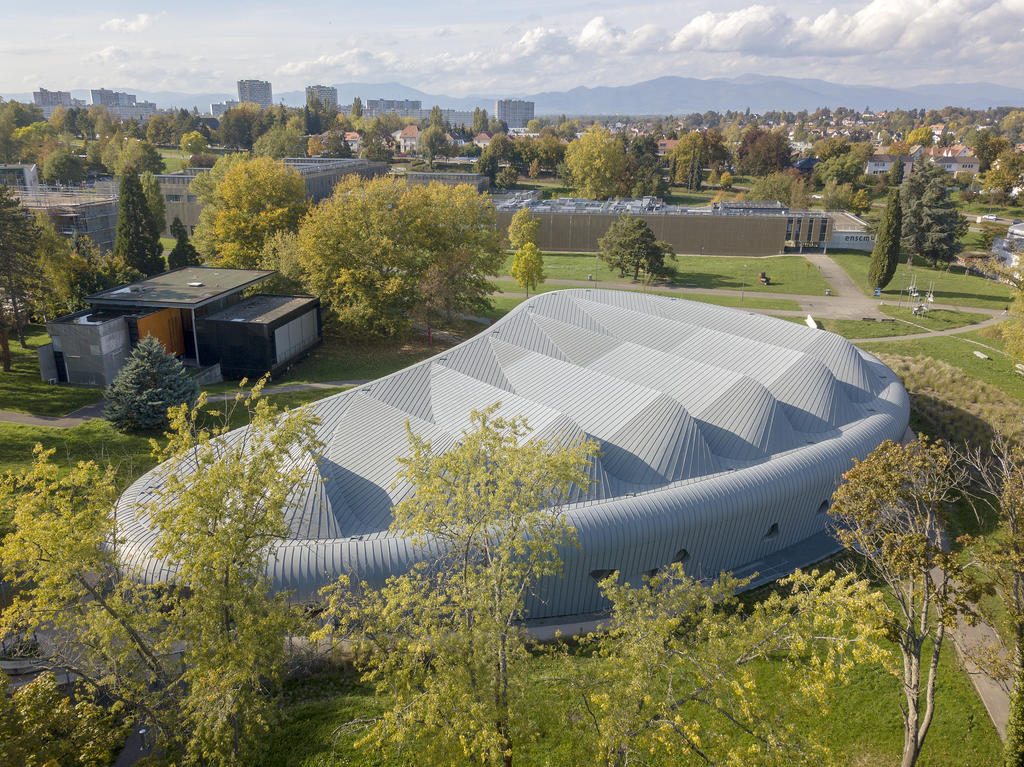
Learning Center, Bibliothèque de l'université, Mulhouse, France. Standing seam zinc wraps roof and walls into one continuous surface
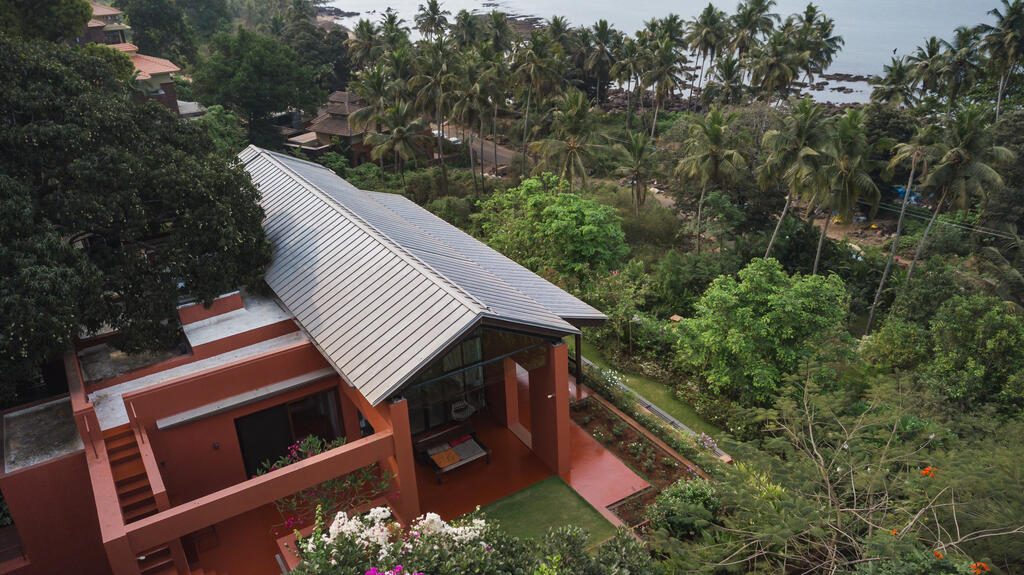
A standing seam zinc roof on a private residence in Goa, where salt-laden coastal air makes finish selection and detailing especially important
QUARTZ-ZINC®: Consistent Matte Grey From Day One
QUARTZ-ZINC® arrives already carrying the soft, matte grey most people associate with an aged zinc roof, achieved through a controlled surface treatment rather than years of weather exposure. Because the pre-weathering process is closely monitored for colour consistency, batches match closely across a large roof plane, which matters a great deal on big commercial or institutional projects. Superficial scratches tend to self-heal back toward the same grey tone, and the finish holds its appearance with very little visible change over the decades. It blends naturally with stone, timber and terracotta, which explains why it turns up so often on mixed-material facades across VMZINC's live project gallery.
ANTHRA-ZINC®: A Darker Finish That Moves Over Time
ANTHRA-ZINC® gives architects the closest thing zinc has to a true charcoal-black roof or facade, with a velvety texture often specified alongside slate or dark photovoltaic arrays. Where it differs from QUARTZ-ZINC is that it doesn't stay static. Depending on exposure and local climate, ANTHRA-ZINC gradually lightens toward a softer grey over the years. That's a detail worth putting in front of the client at concept stage, not something they discover after handover.
It isn't a defect. The same protective chemistry is at work, just visibly so. Superficial marks and light scratching tend to disappear back into the surrounding patina over time, and in coastal or marine-adjacent settings, occasional white surface deposits can show up more visibly against the dark base than they would on a lighter finish. These deposits are cosmetic and don't shorten the roof's service life.
Specifying Zinc Roofing for Indian Conditions
India's range of climates puts patina behavior to a test that a generic spec sheet doesn't always anticipate. Coastal cities carry salt-laden air, northern plains see wide seasonal temperature swings, and industrial corridors deal with higher airborne sulphur. None of this rules out zinc roofing, but it does affect which aspect and thickness make sense for a given site. A few points worth building into the specification:
- Match roof thickness and finish to the site's pollution and humidity profile rather than defaulting to one standard spec across an entire portfolio.
- Specify QUARTZ-ZINC where colour uniformity across a large roof plane matters more than a deep, dark aesthetic.
- Reserve ANTHRA-ZINC for roofs and facades where the design intent can accommodate gradual lightening, and flag that behavior to the client early.
- Detail standing seam or flat-lock roofing systems appropriately for monsoon-heavy regions, where water shedding and joint detailing matter as much as the metal itself.
- Build maintenance expectations into the O&M documentation. Zinc roofs need almost none, rainfall does most of the cleaning, and gutters just need periodic clearing.
Zinc Roofing Questions Architects Ask Us Often
Does a pre-weathered finish eliminate the need to think about patina at all?
No. Pre-weathering gives a consistent starting appearance, but the roof keeps interacting with its environment for its entire service life. QUARTZ-ZINC stays close to its installed colour. ANTHRA-ZINC visibly evolves.
Do scratches during installation or maintenance permanently mark the roof?
Generally not. Both finishes rely on a self-healing patina that gradually covers light surface marks, which is one of the practical advantages over painted metal roofing.
Does zinc roofing's hundred-year lifespan claim hold up in a real Indian climate?
The published figures come from long-term field data and controlled corrosion testing, and the underlying chemistry doesn't change by geography, though local conditions shift the corrosion rate up